-
they can earn quick money without spending a lot.
Studies have shown that people who find their every day routine hopeless and pointless spend more money on tickets. Usually when people are depressed and can`t find a way to get out of poverty they tend to develop addictive behaviors,
such as gambling. There is also peer pressure. If they are surrounded by people who gamble, they too will spend more money gambling, as simple as that.
Poor people see the lottery as their ticket to improve their financial status and finally be able to experience a better life. So, it comes as no online kbc head office whatsapp number surprise when poorer people buy twice as much lottery tickets than wealthier people. This
is showed in another study that was published in the Journal Behavioral Decision Making.
positive or negative towards lottery
To some point, the reasons why poor people gamble are justifiable. They are doing their best to improve their current living situation. Feeling helpless on a daily basis is not good for their mental health so they spend the little money
they have to finally be able to breathe and stop worrying so much. What we found to be of little help is the role of the government. They are actively advertising and they are relying on the poor people for state lottery revenues. And
it is shocking when we see the real numbers and find out how much the poor people are contributing to the overall sales of the industry.
As we said before, our peers have an effect on us. So, it only needs one person to start gambling, and in no time the whole community gambles, so we end up with a network of lottery players who support each other and encourage each
other to play even more.
-
the poorer households.
Harvard came with an interesting find too. They say that the rich tend to play the lottery most often when the jackpot prizes are the highest, while the poor ones play whenever they can, no matter the prize. This is a very sad fact
showing that the poor are really desperate to grab any prize whatsoever. For that reason, daily games gained a huge popularity such as online kbc head office whatsapp number scratch cards. They only offer a fraction of the bigger games jackpot, but for them, even that is
enough.
spendings of Lottery winners
And since a small portion of state lottery profits goes to government services, they are also taking advantage of the situation. They advertize the state lottery towards their poorer citizens, making them contribute to society.
Why the poor choose to play the lottery more There are many reasons why poor people choose to play the lottery more often. One study made in Germany in 2012 says that poor people feel the social deprivation compared to their wealthier counterparts, and the lottery is the only way
-
investing online lottery
It seems that people who can`t afford to gamble, actually spend most of their time and money gambling. So, no matter how little money they`ve got, they are willing to spend it on lottery tickets. The idea behind this is that they see
lottery games as a small investment that could change their lives for the better. It should be a quick escape from their current living conditions.
Another study shows very worrying results. It was conducted by Duke University and it shows that one-third of the poorest households online kbc head office whatsapp number actually contribute to half of all lottery ticket sales. Another worrying statistic reported by North
Carolina Policy Watch said that 18 out of 20 countries with higher poverty rates, contributes $200 per adult spent on tickets.
Lottery ticket sales reach its peak in 2014 with 70,5 billion. Other entertainment sectors only gathered a fraction of this. On average, that is $300 spent on tickets for every adult in 43 US states. And again, the most money came from
-
Who Plays Lottery more: Rich or poor people?
Lottery, in general, is a very tempting business. Who doesn’t like a chance to win thousands, even millions of dollars, just by investing a small portion of their paycheck? The idea is attractive to those who are proud to say they are
financially stable, and to those who aren’t.
So, the question now is, who plays the lottery more often? Those who already have enough or those who struggle to make ends meet. Well, just out of curiosity, let`s dig deeper and see!
What does the research say?
Well, it comes as no surprise that the lower class is the leading participant of lottery games in the US. The focused study included online kbc head office whatsapp number 4000 participants across the state and it was conducted in 2010 by Grace M. Barnes, John W. Welte,
Marie-Cecile O. Tidwell, and Joseph H. Hoffman, and published in the Journal of Gambling Studies in 2011. The study was specifically focused on lottery gambling and included games like scratch cards, daily numbers, and lotto games.
The results were kind of expected. Participants with the lowest socioeconomic status have the highest rate of playing the lottery. They also spend more days gambling, while the people with higher status spend, on average, only 10 days
gambling.
-
He also stated that the first thing he did with the prize was paying off his mortgage.
The winning combination of that raffle was the one made up of numbers 2, 9, 17, 19, 22 and 36. The owner of the store where the ticket was sealed, William Ho, was almost as excited as the winner: “We have been here 15 years and we had
never sold a top-notch prize . I am very happy … and more when I saw that we had sold not one, but two top prizes. It’s great news. online kbc head office whatsapp number We wish our customer all the best with their double prize.”
It is not the first time that a similar episode happens: last April, another Australian, this time from Melbourne, bought two identical tickets for the same draw, with the difference that, in this case, he did it on different days and
in different lottery offices. His ‘mistake’ earned him two millionaire awards: in total, 29 million Australian dollars, almost 18 million euros.
-
Canvas painting
Since folklore was associated with the Indian identity, many artists who were part of the Bengal School of Thought adopted these themes and painted scenes from Indian mythology and epics Ramayana and Mahabharata. A few of these artists were Laxman Pai and Ganesh Pyne. Apart from them Raja Ravi Verma and Srilankan Artist George Keyt are also famously known to depict mythological characters in their works. Some young contemporary artists include painter Vasudeo Kamath, illustrator Anirudh Sainath and artist Jayasri Burman.
Ganesh Pyne’s works have extensively included depictions of scenes from the Epic Mahabharata. He was brought up in a religious atmosphere and recollects his grandmother telling him these mythological stories. He later incorporated them in the majority of his work. The above painting is called ‘Charioteer’ and is inspired by a scene from the epic Mahabharata. Pyne has depicted the chariot of Arjuna on one side with a half-painted horse on which there is a silhouette of Lord Krishna. Here the artist has shown the agony of Arjuna over unwillingness to fight the battle against his loved ones.
Raja Ravi Verma
This painting depicts Lord Vishnu and his wives on Shesh Nag. This artwork was displayed at the India Art Fair 2020 earlier this year and caught many eyes owing to its realistic yet mythical representation of Lord Vishnu.
George Keyt
Image Courtesy: Dhoomimal Gallery Collection
George Keyt is a Srilankan by nationality, but since Sri Lankan and Indian cultures are very similar, he drew inspiration from the Indian Folktales. This ink on paper artwork is a scene from the story about the Indian river Kaveri.
Vasudeo Kamath
Vasudeo Kamath is an alumnus of Sir J. J. School of Arts and enjoys painting mythological characters in his works. His artwork titled ‘Heart is where soul is’ is revered as one of his bests. It is an interesting representation of how the stories pour out into real life. He is seen painting Lord Ram, Sita and Laxman while talking to Hanuman who is seemingly floating in his studio.
Anirudh Sainath
This illustration depicts a modern representation of Lord Ganesha on his wahan (vehicle) and has a game inspired aesthetics to it. This only shows the appeal and popularity of the mythological characters in the Hindu religion.
Art in all its dimensions – tribal, rock, ancient or contemporary – is today a well established discipline all over the world. It is clear that it is important to study in detail this aspect of the cultural heritage of humankind. Canvas painting Increasing interest in this area has also led to a healthy questioning of certain theoretical frameworks that had formed the unquestioned base for most of research in Art. Today, the old sytlistic and other chronologies are being questioned, and there is considerable reliance on studies based on comparative ethnographic data, in the interpretation of Art, especially Rock and ethnographic or what one labels as “tribal”. Equally important is the awareness of the limitations of this research, especially because the subjectivity of the researcher’s own – personal and social – viewpoint is a crucial variable. Subjectivity here does not merely refer to the individual, it also points to the cultural biases, say, the Euro-centrism whereby all Art traditions are judged, e.g., Palaeolithic art was supposed to have emerged from this geographic region, along with perceived cultural significances and attributes within certain ‘evolutionary’ schemes.
This focus on Euro-centric – Western – view along with its frameworks, methodologies was then sought to be duplicated in other parts of the world. Of course, many have realised the futility of this kind of this enterprise because it lead to a tremendous neglect of understanding indigenous traditions, their theoretical models and regional temporal distributions. The error is now being rectified, and the interest is now shifting, because of this very questioning of older categories and pigeon-holing of the various categories of Art. This paper stresses the point that Art maybe viewed within certain universal, creative and general artistic traditions of humankind as such. For instance, is it not possible to understand and visualise “tribal” Art within wider possibilities, in the sense of a cosmogonic and universal creative act whereby this common cultural heritage provides a link for the contemporary dilemma which faces us today?
The nature of Art, as a universal phenomenon, is certainly known in the sense of being a cultural manifestation of all societies, past and present. Many different populations lay claim to this heritage in terms of their cultural and political identity. It is also in terms of humankind’s search for its common identity – psychological and biological – that Art transcends regional identities. In the application of sophisticated techniques, taking into account ecological conditions, the cultural correlates and contexts, the study of “tribal” art is also a universal phenomenon.
The present paper hints at some of these aspects of universality, as a creative act. It is important to show the background and the emergence of Art itself within the modern context. For instance, one can show how Art as a concept is limited by specific notions governed by various cultural connotations, e.g., more by monolithic definitions and the like, rather than by other sensibilities and freedom of expression that maybe common to all of human kind. The contemporary image of art as mere aesthetic beauty, in terms of formal qualities – beyond mere utilitarian purposes – is also a limited way of recreating the perception of other cultures in the production of the images of Art.
In short, the modern ways of seeing Art by and large ignores any form of a world vision, i.e., there is little consideration of any cosmic view. This is an ability which all human beings have, irrespective of time and place, that allow one to be in touch with the supernatural or the noumenal dimension. This kind of knowledge was widely prevalent amongst nonindustrial traditional societies who had their own way to know, to express and to manifest it as Art. For instance, one knows that there is continuity both in time and space between Rock Art and such traditions which continue even until today. It is in this sense that ethnology, myths, beliefs, other traditions throw alternate ways of viewing Art. However, in the modern context of the rapid growth of industrialised urbanised settings even in developing countries, the older traditions are fast vanishing and are being lost as has happened already in the Euro-American context.
-
gond painting
Mithila painting is one of the world’s most precise types of people artwork, created by means of ladies, maintained by way of girls and still practised by way of ladies and now by way of guys too. Selectiveness is the beauty of this art shape in its innovative expression. In ancient instances, on auspicious days, this art changed into made on mud-walls or soil-floor and was erased the very next day. And that is why those works have no longer been preserved. While, as the commonplace oral lifestyle shows, the beginning of this artwork form dates again to the ramayana period (ancient india), it went thru one-of-a-kind levels of history gond painting at some stage in the mediaeval duration and little or no history is understood of this time. The portray of mithila or bhitti chitra (aka graffiti) turned into located whilst a chief earthquake struck bihar in 1934. William g. Archer, the british colonial officer of the madhubani district, noticed these artwork in the indoors walls of the houses as he inspected the harm because of the earthquake. Issues and colour patterns in madhubani art:
the artwork are, basically, spiritually stimulated. In both images, the vital subject matter is passion and fertility. They are made in specific rooms in the domestic, along with the prayer room, the ceremonial vicinity, the bridal room, or the village’s most important walls to greet visitors, and so forth. The sketches of nature and mythology are changed and tailor-made in step with the topic of each vicinity, as well as the person artist. Worshiping hindu deities and episodes of their holy texts, the monkey, the solar, the moon, the vine of tulasi (basil), the deep (it is an average lamp product of soil, a token of a peaceful life), marriage scenes and different social sports are the most drawn themes and patterns. Women pray to the divinities before beginning the art, in order that their favour accompanies them of their aspirations or rituals. The cotton wrapped on a bamboo stick is used as a brush for its interpretation. The colors which might be introduced are processed through the artists manually. The black color is ready by combining the blight with the cow dung; the yellow shade is prepared with the aid of mixing curcuma and banyan leaf milk; the blue color is derived from the indigo; the purple color of the kusum (ceylon oak) flower; the green color of the applewood tree; the white shade of the rice powder; and the orange shade of the palash (bastard teak) flower. Reddees / shutterstock. Com
the works of artwork on mud-partitions were now not a symbolic reflection of the testimonies of the epics; as a substitute, they were particularly linked to hindu myths and a real representation of it. This art’s incessancy became due to the natural and dwelling portrayal of social lifestyles in which there has been a deep interconnectedness among people. There were additionally close ties to the usage of colorings for religious values and hopefulness for their nicely-being. Did you recognize? The madhubani art shape saved a wooded area from being reduce down! In 2012, approximately a a hundred trees have been painted inside the madhubani style. Shashthi nath jha, owner of the ngo called gram vikas parishad got here up with this initiative if you want to store trees that have been being cut right down to widen the roads. This proved to be a successful way to elevate consciousness amongst villagers of its affects, along with climate alternate and global warming. Exciting, right? Greater unexpected is that although the campaign changed into a luxurious one, no longer a single tree was cut down (the villagers used synthetic paint to make the artwork final longer). The primary explanation in the back of this became that the bushes had been painted with gods and other divine and philosophical pix, and other mythologies. This instilled admire and discouraged the elimination of the trees.
-
WARLIView fullsizeHarvesting Dates
The Warli tribe settlements spread all over the Thane district of the state of Maharashtra. They are innate artists and their painting tradition is more than 1200 years old. The paintings on the walls of the their huts are traditionally done by the women of the tribe and are greatly influenced by the their surroundings and day to day life. These wall murals are done on red mud or cow dung layered walls and the figures are painted with a rice-flour mix, which could be Bhil painting and re-painted every season. The traditional life of the Warli reflects their interaction, or more precisely, their co-existence with nature. The Warli believe that everything in this world interacts: the actions of humans and the harmony of space. The universal harmony is maintained by the implicit unique communication between humans and deities.
These extremely rudimentary wall paintings use a very basic graphic vocabulary: a circle, a triangle and a square. The circle and triangle come from their observation of nature, the circle representing the sun and the moon, the triangle derived from mountains and pointed trees. Only the square seems to obey a different logic and seems to be a human invention, indicating a sacred enclosure or a piece of land. Human and animal bodies are represented by two triangles joined at the tip; the upper triangle depicts the trunk and the lower triangle the pelvis. Their precarious equilibrium symbolizes the balance of the universe, and of the couple. These tribal art startle visually without the prop of color and with a remarkable economy of detail.
-
Bhil painting
BHIL ART: TRIBAL PAINTINGS FROM INDIA
Amy Lin of Saffronart explores the wonders of Bhil art and their significances
gond_12_08454_big Bhuri Bai
Untilted The Story by Saffronart
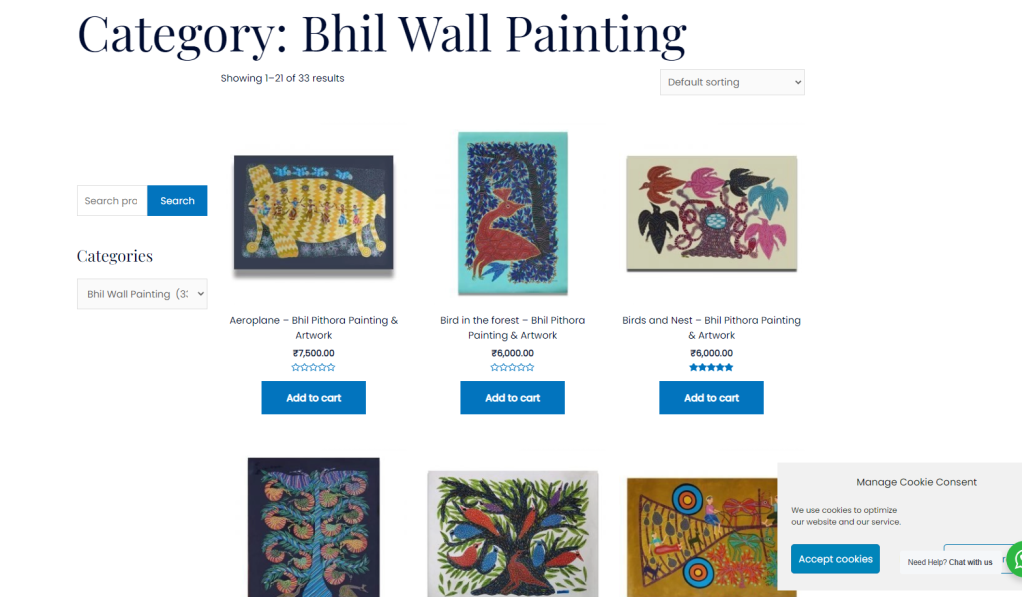
New York: Tribal art has been gaining popularity in recent years due to the rich cultural heritage it reflects and the bold creations it results in. In a previous post, we discussed Gond art in celebration of the first Indian Folk and Tribal Art Auction held at Saffronart. After with the Gonds, the Bhils are the second largest tribal community in western and central India. Their art focuses on their natural environment filled with songs, rituals, tattoos and folklore. In a new collection on The Story by Saffronart called Rhythms and Rituals, we’re featuring some fantastic pieces from celebrated Bhil artists.
The tradition of Bhil painting first stemmed from the home. Upon visiting a Bhil household, one will discover a delightful myriad of images from myth and folklore adorning their walls and ceilings. Every year, a new plaster of mittichitra (clay relief work) and paintings are applied to the interiors of the house. Pigments are ground from natural materials and leaves and flowers, while brushes are made with neem twigs.
Pithora horses are a common theme among Bhil artists. The traditional painter or lekhindra often paints pithoras as an offering to the goddesses. According to legend, the people of the Kingdom Dharmi Raja have forgotten how to laugh. The brave prince Pithora rode on horseback through a dangerous terrain and brought back laughter and joy from the goddess Himali Harda. Similar to all Bhil painting adivasi tribes, the Bhils live close to nature and lead a largely agricultural life. Their paintings reflect the changing seasons, the natural phenomena that guide their harvest, and the gods that protect them.
Subhash Bheel Untitled The Story by Saffronart Subhash Bheel
Untitled The Story by Saffronart
Bhuri Bai of Zher is one of the leading Bhil artists of our time. She started painting at a young age when the colors at a local festival inspired her to paint laughing goddesses and everyday scenes from the village. Her mother taught her how to make huts and decorate them with cows that became a prominent symbol in her work. In her adult life, she transferred the paintings from mud to paper and canvas, and continues to decorate the walls at the Museum of Mankind in Bhopal.
gond_12_08456_big Lado Bai
Untitled The Story by Saffronart
Another prominent artist is Lado Bai whose art reflects the spirituality and animism of her community. For years, she could not pursue her art because of financial constraints. Her luck turned when she was discovered by the famous Indian artist Jagdish Swaminathan. Swaminathan encouraged her to work for the Adivasi Lok Kala Academy where she had the opportunity to transfer images of festivals, rituals and animals from wall to paper.
Bhil artists are just starting to be internationally recognized. They paint the simple human joys of birth and other ceremonial occasions like harvests that are often forgotten in our modern society. The art of the Bhils along with that of other tribal groups reminds us what the simple pleasures in life are.
-
Paper painting
Origami Paper Lights by Handwork Studio
Well known forms of Paper Craft include Paper Flower making, Decoupage, Papier Mache, Origami, Paper Cutting, Quilling and more. Papel Picado is practiced in Mexico and other places in Latin America and is done Paper painting using chisels to cut 50 to 100 sheets at a time, while Chinese paper cutting uses knives or scissors for up to 8 sheets at a time. Wycinanki and other European forms usually are done on one single sheet. In either of these traditions, paper sheets are folded prior to cutting to achieve symmetrical designs. And of course we all know about the famous craft of Origami which is Japanese in origin.
Clockwise from left Paper Cut Light Box, Paper Rose,Paper Quilled Wall Art, Origami Lamp
Lately – Paper Craft Artists have created some of the most incredibly intricate 3D art ever seen. Master paper sculptors cut, fold, glue and otherwise transform sheets of paper in various colors, sizes and textures into complex creations that mimic architecture, nature, the human form and subjects that are purely the products of their own fertile imaginations.
We’re delighted to share the work of our versatile craftspersons who have used paper to craft flowers, 3 D and 2 D papercuts, lamps, jewellery, clutches, baskets, bowls, napkin holders and much more. Delicate, intricate, one of a kind. And so incredibly beautiful.
Explore this versatile medium with us.
Lead image: Handmade Paper Ixia by Pot Of Earth
-
Subscribe
Subscribed
Already have a WordPress.com account? Log in now.
 tribalartindia